From Alex
I am Dr. Alex Belser, a licensed psychologist and clinical scientist, and I made this site. For most of my career I have worked at the meeting point of psychology and human transformation, and I have returned again and again to a simple observation: the people in your life hold knowledge about you that you cannot reach alone, and almost no one ever asks for it.
I built Seen From Many to ask for it well. Its method, the Belser Social Reflection Practice, gathers forms of interpersonal awareness that psychologists and group therapists have refined over a century, and shapes them into a process that an ordinary person can offer their circle: structured enough to be safe, honest enough to matter, and anonymous enough to be true. You can read more about me and my work at alexbelser.com, and you can read how the practice combines these traditions with new techniques of its own.

Acknowledgments
In building Seen From Many, I understand myself as a weaver, not an inventor. The threads gathered here, from the questions and the exercises to the very idea that the people around you can reflect you back to yourself, were spun by generations of clinicians, researchers, group leaders, and practitioners who came before me. It would be a distortion of the truth to suggest I conjured any of these strands anew. What is mine is only the braid: a way of bringing time-honored practices of interpersonal awareness into one careful, asynchronous, online process. I name my sources here with gratitude, and in the conviction that honoring a lineage is part of practicing it well.
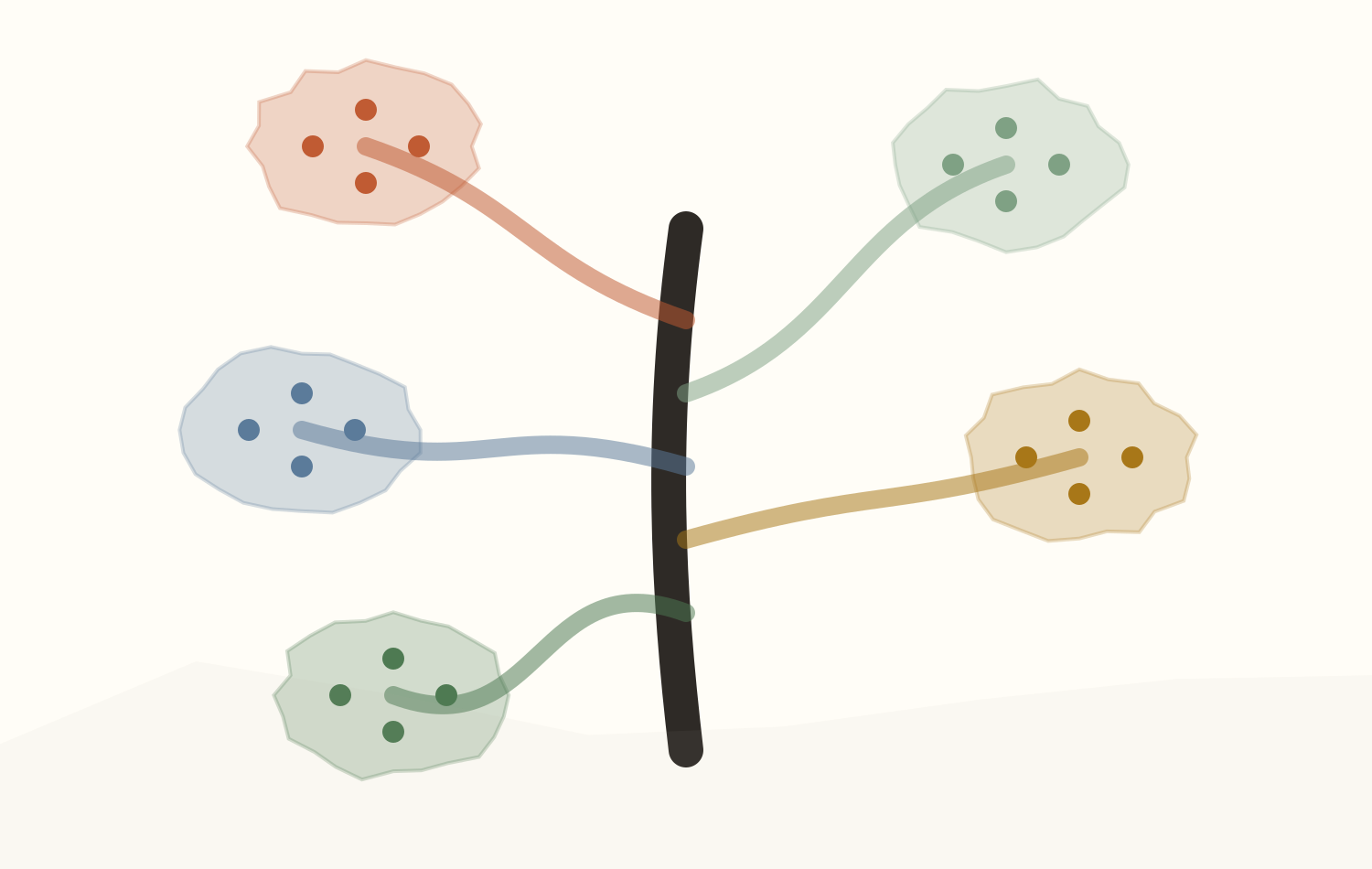
I begin with the two traditions that form the heart of the process. The Johari Window was created by psychologists Joseph Luft, PhD, and Harrington Ingham, MD (Luft & Ingham, 1955), whose elegant four-paned model of the open, the blind, the hidden, and the unknown remains, seventy years on, one of the most humane maps of self-knowledge ever drawn. The second movement, in which you and your circle independently choose adjectives and discover the overlaps and the gaps, is a direct adaptation of their original exercise, and my debt to them is written into every pane of the report. From Appreciative Inquiry, developed by David Cooperrider, PhD, with Suresh Srivastva, PhD, at Case Western Reserve University (Cooperrider & Srivastva, 1987), I learned to begin not with the question of what is wrong with a person, but with the question of when they have been most fully themselves. I learned as well that strengths, witnessed and storied by others, are as developmentally potent as any diagnosis. The first movement, with its requests for remembered moments rather than ratings, walks the path they cleared.
The wider practice of multi-rater, or 360-degree, feedback grew up in organizational psychology and leadership development over the second half of the twentieth century, stewarded by institutions such as the Center for Creative Leadership. I have borrowed its structural insight, which is that convergence across many independent perspectives is more trustworthy than any single account, while deliberately carrying it out of the boardroom and into the whole of a life. Behind that tradition stands Kurt Lewin, PhD, and the T-group movement of the National Training Laboratories at Bethel, Maine, where in the late 1940s the practice of structured interpersonal feedback was, in a real sense, invented. There the radical discovery was made that people can tell each other, with care, how they are experienced.
From the group therapy traditions I have taken more than I can fully repay. The group relations work of the Tavistock Institute, and of Wilfred Bion, DSO (1961), taught me that a group holds knowledge about each of its members that no individual conversation can surface. The encounter group movement of Carl Rogers, PhD (1970), Will Schutz, PhD, and the community at Esalen insisted that honest, immediate, personal feedback between people who care for each other is not a danger to be managed but a nourishment most people are starving for. Irvin Yalom, MD (Yalom & Leszcz, 2020), and the interpersonal tradition of group psychotherapy gave me the here-and-now question that anchors the third movement. That question is not what you are like. It is what happens between two people when they are together. The relational items, on feeling heard, on safety in conflict, and on leaving time together more alive, are children of that tradition.
From Gestalt therapy, created by Fritz Perls, MD, and Laura Perls, DPhil (Perls, Hefferline, & Goodman, 1951), I took the discipline of present-tense, first-person awareness, and I took the empty chair. The empty-chair practice itself descends further back, to Jacob L. Moreno, MD (1934), the founder of psychodrama and of sociometry. Moreno understood, perhaps before anyone, that the web of how people in a group perceive and choose one another could be made visible, and that speaking to an imagined other can unlock what speaking about them cannot. When a Reflector in Seen From Many imagines their friend sitting across from them, able to really hear, and writes what needs to be said, they are practicing Moreno's and the Perls' art in written, asynchronous form. I hope I have carried it gently.
The sentence stems, such as "When I'm with you, I notice I feel..." and "I feel closest to you when...", are adapted from the practices of Authentic Relating and Circling, developed and stewarded over the last three decades by communities of practice including the Bay Area circles around Guy Sengstock, Authentic World, and Circling Europe. These communities took the encounter tradition and refined it into a repeatable, teachable art of being with another person. The sentence-completion method itself owes much to Nathaniel Branden, PhD, who demonstrated how an unfinished sentence can slip past a person's defenses. The card sort descends from the Q-methodology of William Stephenson, PhD, which showed that asking people to sort and rank is a fundamentally different act, and often a more honest one, than asking them to rate.
The fourth movement, on life direction, draws on the narrative identity research of Dan P. McAdams, PhD, who established that human beings are storied creatures, and that the people who know you carry versions of your story, including its possible future chapters, that you cannot draft alone. The questions about avoidance and self-sabotage owe a debt to Robert Kegan, PhD, and Lisa Laskow Lahey, EdD, whose Immunity to Change work maps how hidden commitments quietly run a life. Beneath the third movement's attention to closeness, conflict, and repair runs the attachment research lineage of John Bowlby, MD, and Mary Ainsworth, PhD, the science of how people bond, protest, withdraw, and reconnect.
A closer cousin deserves its own naming. The Reflected Best Self Exercise, developed by researchers associated with the University of Michigan and its Center for Positive Organizations, invites a person to gather stories from their own circle about moments they were at their best, and to compose from those stories a portrait of their strengths (Roberts, Dutton, Spreitzer, Heaphy, & Quinn, 2005). Seen From Many was inspired in part by that exercise, and by the way it demonstrated that structured reflections gathered from one's own community can be rigorous, moving, and safe. The first movement in particular walks ground the Reflected Best Self Exercise mapped, and like the other traditions named here, that exercise itself draws from and contributes to existing frameworks of strengths-based development. I honor it gladly as an inspiration, and you can learn about it at reflectedbestselfexercise.com.
The newer instruments of the practice carry debts of their own, and I name the principal ones here as well: James Pennebaker, PhD, and the expressive writing tradition (Pennebaker & Beall, 1986); Joseph Wolpe, MD (1958), and graded exposure; Irwin Altman, PhD, and Dalmas Taylor, PhD (1973), whose social penetration theory described how disclosure deepens by degrees, and Arthur Aron, PhD, whose escalating questions (Aron et al., 1997) and Inclusion of Other in the Self scale (Aron, Aron, & Smollan, 1992) demonstrated it; L. L. Thurstone, PhD (1927), and Allen Edwards, PhD (1957), whose paired-comparison and forced-choice formats were built to loosen the grip of social desirability; Stephen Finn, PhD (2007), and Therapeutic Assessment; Michael White and David Epston (1990), founders of narrative therapy; Ethan Kross, PhD, and Igor Grossmann, PhD (2012), and the science of self-distancing; George Lakoff, PhD (1973), for the linguistics of hedges; Richard Schwartz, PhD (1995), and Internal Family Systems; Ian Ayres, JD, PhD, and Cait Unkovic (2012), whose information escrows, carried into practice by the makers of Callisto, showed that conditional disclosure could be built in software; Latanya Sweeney, PhD (2002), and the science of de-identification; Virginia Satir (1972) and family sculpting, with David Kvebaek (Cromwell, Fournier, & Kvebæk, 1980), whose sculpture technique read relationships in the distances between figures; Eugene Gendlin, PhD (1978), and the felt sense; and Lauri Nummenmaa, PhD, and colleagues (Nummenmaa et al., 2014), whose bodily maps of emotion showed that people reliably know where in the body a feeling lives. How each of these informs a specific instrument is set out on the method page.
One more debt is older than all of these. In 1786 Robert Burns wished for "some Pow'r the giftie gie us, to see oursels as ithers see us." The whole of Seen From Many is an attempt to build a small, careful version of that gift.
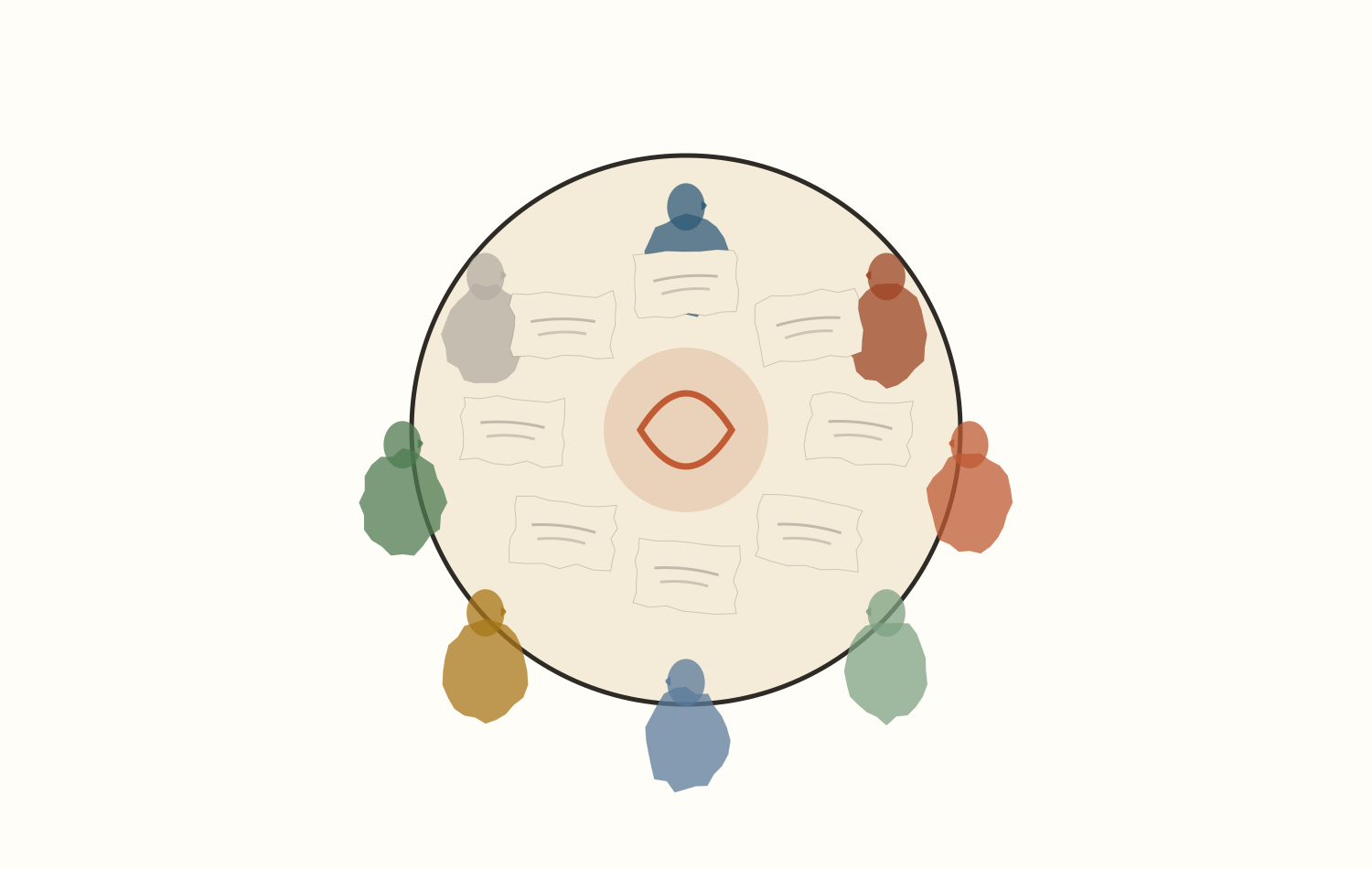
Finally, I thank the people without whom this practice is only a set of forms. Every Reflector who has sat down with twenty minutes and a full heart to tell a friend the truth, the warm truths and the hard ones, offered with care, is part of this lineage now, and so is every person brave enough to be the Seen. Feedback given in love is an old, old practice. Thank you for keeping it alive.